
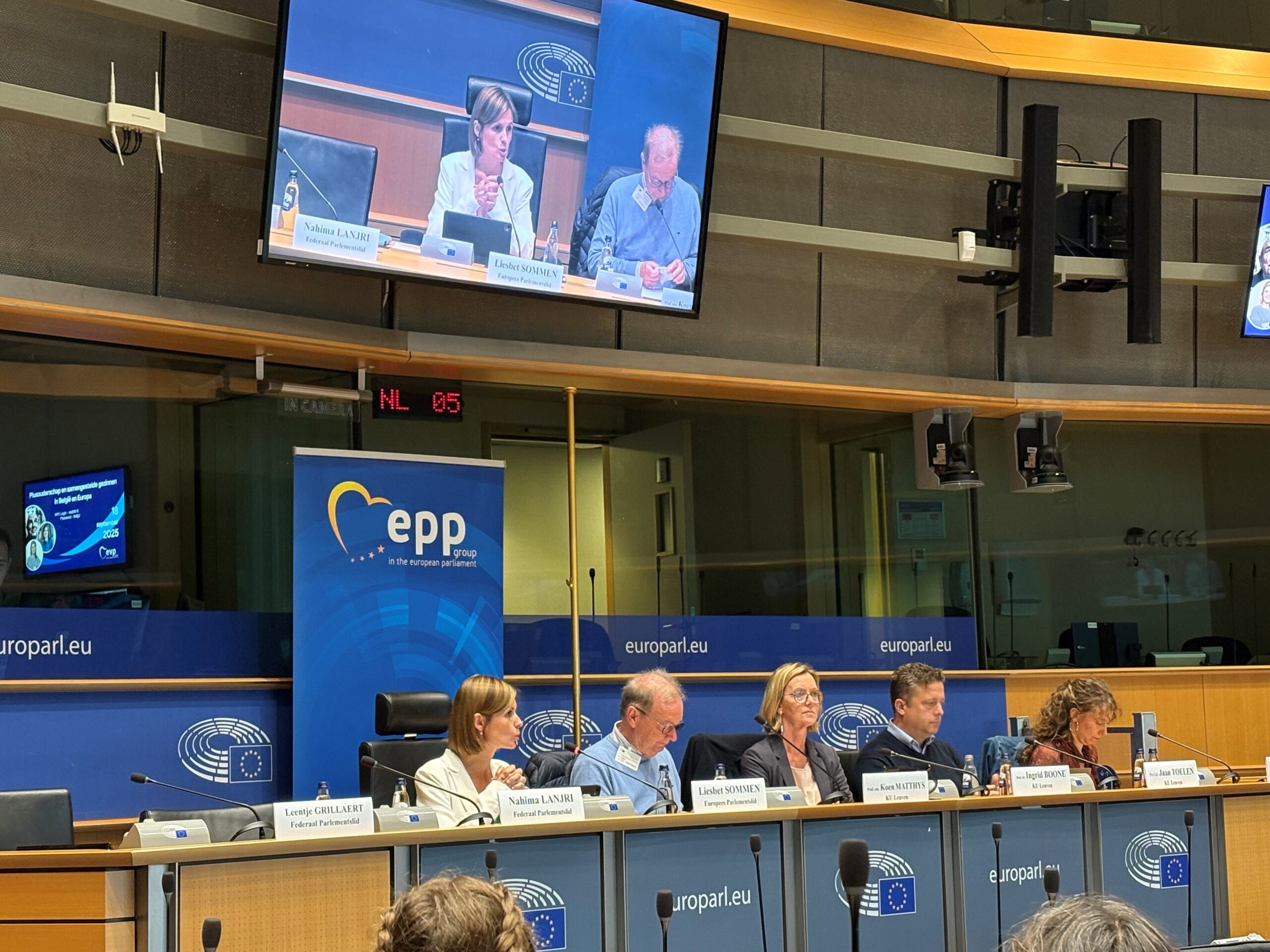
European study seminar on blended families
‘Plus-parenting and co-parenting in Belgium and Europe: legal, social and emotional challenges in families.’ This was the title of a study seminar hosted by Liesbet Sommens MEP (member of the European Parliament EMPL committee), attended by COFACE Families Europe in the European Parliament, as well as COFACE members like Gezinsbond and Ligue des familles. Gezinsbond has especially been active to draw attention to the situation of blended families highlighting in a recent press statement that “legally, plus parents remain strangers to the child and calling for laws to be adapted to the reality of families today.”
The study seminar focused on the complexity of plus parenting and co-parenting in a cross-border context within the EU. Speakers highlighted the legal uncertainties and challenges associated with these forms of parenting in Belgium, comparing them with legal developments in neighbouring countries. The medical context was also discussed, as healthcare providers are increasingly confronted with situations involving plus parents. Practical examples were used to further illustrate the medical complexity. Finally, they considered the socio-economic barriers and the impact of these dynamics on children and on emotional relationships within blended families.
The session consisted of two parts. In the academic part three speakers examined the topic from a legal and social perspective, highlighting data on blended families in Belgium and neighbouring countries.The policy part included a debate with different representatives providing input and recommendations based on the current discussions in Belgium and Europe, referring to practices in neighbouring countries such as The Netherlands.
PhD student Bieke Maes focused on social and emotional challenges: An increasing number of children are growing up with a step-parent (or ‘plus parent’ which is the term used in Flanders). But what exactly is the role of a step-parent in today’s society? And how do other family members view that role? She referred to her own research as well as research of colleagues on co-parenting in Belgium.
Ingrid Boone focused on the legal challenges. Plus parenting, or co-parenting takes various forms today: co-parenting after a divorce, co-parenting without a prior partner relationship or with more than two (intended) parents. In addition, plus parents are often involved in the upbringing of children in blended families. She focused on the current legal framework for co-parenting and plus parenting in Belgium, the challenges that arise (due to rigid family laws designed on the basis of traditional family notions) and possible (future) legal reforms.
Jaan Toelen focused on case studies of plus parenting in a medical context: Making medical decisions for children is often complex. The doctor must take into account the opinion of the child (as soon as this is possible) and that of both parents. However, in our society, more and more children are growing up in new blended families, where not only the legal parents but also plus parents play an important role in their upbringing. Nevertheless, plus parents in Belgium have no formal say when it comes to medical decisions for the children they care for on a daily basis. He highlighted this issue and also explained the perspective of Flemish parents and paediatricians on the possible role of plus parents in consultations with the (paediatric) doctor.
Leentje Grillaert & Nahima Lanjri, members of the Belgian federal parliament, referred to different initiatives which are on the table of discussion at federal level which could pave the way for greater recognition of plus parents. There is a proposal in Belgium for a new, more flexible family leave system based around a “24-month family credit” (or “familiekrediet”) per child. It would consist of a “backpack” (rugzak) of 24 months leave rights per child. Parents and other family members (such as plus parents) could flexibly use those 24 months to look after the child. The leave could be taken by the mother, father, co-parent, or even grandparents or step-parents. To be used until the child is 18 years old (or 21 if the child has a disability)
Liesbet Sommen MEP ended with a reflection on the role of Europe in supporting plus parents like herself (mother of two and “plus mother” of three). She referred to the cross-border dimension, namely the proposal for a regulation on parenthood recognition across countries which could open the door to more formal recognition of plus parents migrating within the EU. She also referred to the status of informal carers in Belgium, which opens up a series of rights, and compared this to plus parents and the need for recognition of their status.