

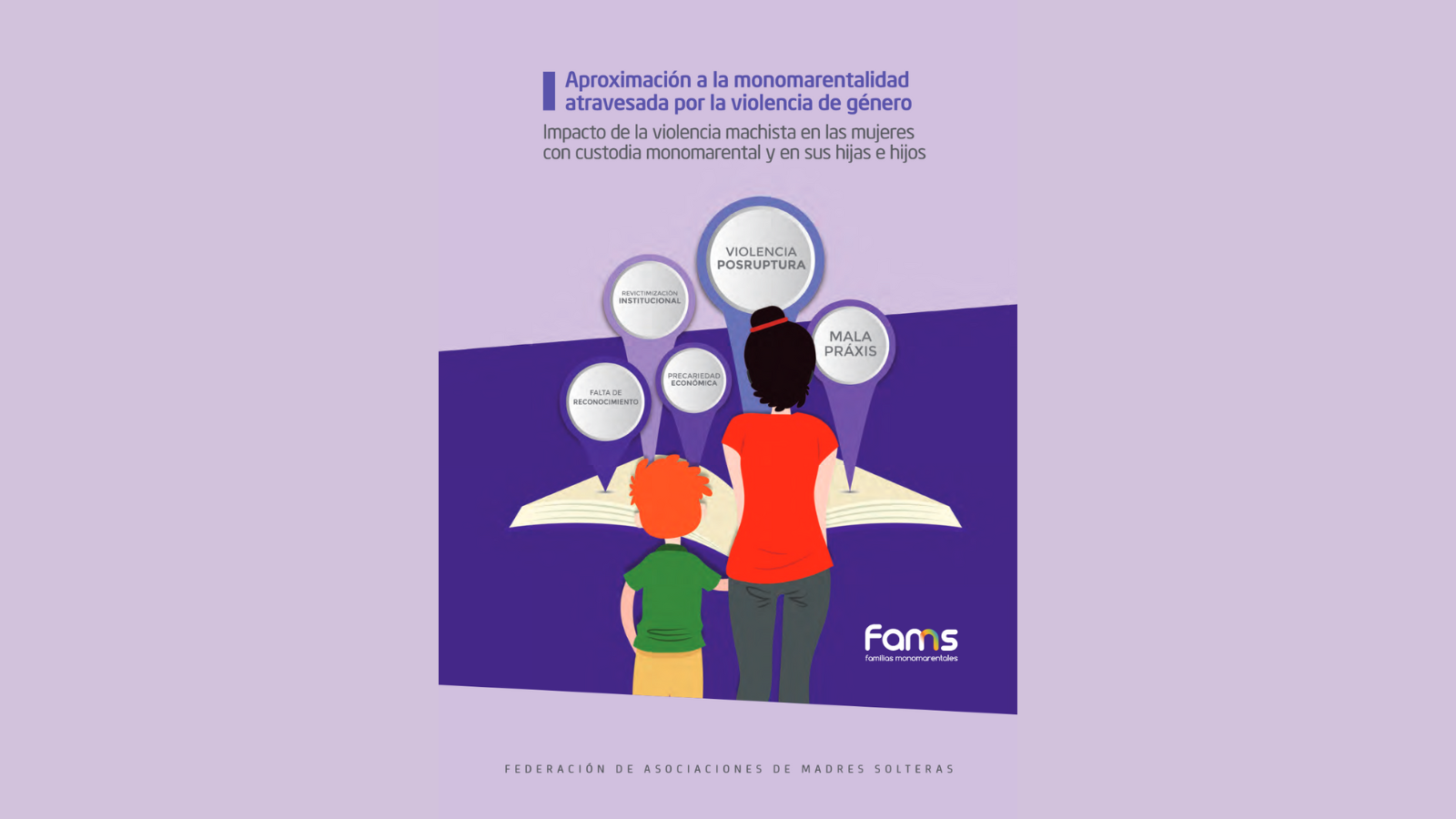
The Spanish member organisation FAMS (Federación de Asociaciones de Madres Solteras) has published a new study examining the relationship between single-parenthood and gender-based violence, with a specific focus on women-led single-parent families in Spain.
The study, titled “Aproximación a la Monomarentalidad Atravesada por la Violencia de Género”, brings together the findings of two studies that explore how situations of single-parenthood are often derived from and shaped by experiences of gender-based violence. The full study is now available online on the FAMS website.
Presentation at the Instituto de las Mujeres
The conclusions of the study were presented on 27 November at the Instituto de las Mujeres in Spain. This presentation provided an opportunity to share insights on how gender-based violence impacts family structures and contributes to the formation of monomarental households. According to FAMS, the combined approach of the two studies helps highlight the complex social realities faced by single mothers who have experienced violence.
The event also served as a platform to underline the importance of recognising these family situations within public policies addressing equality, social protection and violence prevention.
Highlighting gendered and structural challenges
Through this research, FAMS seeks to raise awareness of the structural links between gender-based violence and single-parent family situations. Women-led single-parent families already face a higher risk of poverty and social exclusion, and those affected by violence often encounter additional challenges related to safety, access to services and long-term stability.
The study contributes to ongoing discussions on the need for gender-sensitive and family-focused policy responses, ensuring that the specific needs of single mothers affected by violence are adequately addressed.
Institutional support
The study was funded by the Spanish Ministry of Equality (Ministerio de Igualdad), reflecting institutional support for research addressing gender-based violence and its impact on families.
Access to the study
Read the full study “Aproximación a la Monomarentalidad Atravesada por la Violencia de Género” here.