
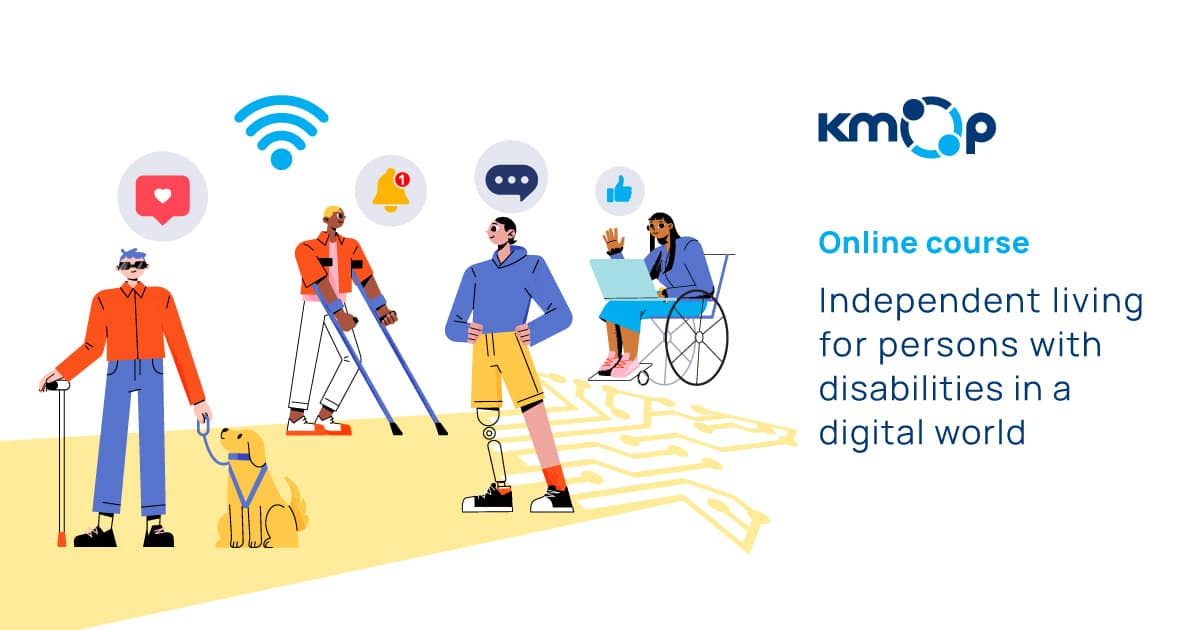
With the launch of two new educational platforms, KMOP, a member of COFACE Families Europe, aims to empower persons with disabilities and the professionals who support them with tailored digital tools, resources and training to foster independent living in an increasingly connected world.
People with disabilities often face a “double divide”, not only barriers tied to physical, societal or institutional accessible design, but also exclusion from the digital sphere. Lack of digital skills or accessible digital environments further restrict opportunities for employment, education, civic engagement, social interaction, and everyday tasks.
KMOP’s new platforms seek to bridge that gap by combining digital skill-building with psychosocial support and personal empowerment. They are built on a practical, person-centred, and inclusive model. Not as a stand-alone digital tool, but as part of a holistic approach to independent living. Digital inclusion is no longer optional, it is essential for autonomy and social participation.
Two complementary platforms: for persons with disabilities & professionals
KMOP’s initiative comprises two interlinked training platforms, each targeting a different but mutually reinforcing audience:
1. Platform for Persons with Disabilities
This was designed with accessibility and personalisation in mind. Through tutorials, exercises, and resource modules, participants can:
-
Improve their social and digital skills;
-
Gain confidence and autonomy in day-to-day life;
-
Engage more actively in their communities.
Importantly, the learning paths can be adapted to each user’s pace, needs and starting skill level, rather than using a one-size-fits-all approach.
2. Platform for Professionals Working with Persons with Disabilities
This platform offers asynchronous training modules, blending theory with real-world case studies, and is accessible even to professionals who have limited prior digital expertise. It focuses on:
-
-
Communication and social empowerment;
-
Applying universal accessibility strategies in practice;
-
Recognising diversity in needs and tailoring support flexibly.
-
By strengthening the capacity of professionals and simultaneously equipping persons with disabilities, KMOP aims for a virtuous cycle: better support leads to better outcomes, which then feed back into improved service delivery and social inclusion.
These new platforms are an excellent example of how digital empowerment and social policies intersect. They align with COFACE’s mission to strengthen families and promote social inclusion, particularly for often-marginalised groups. It also shows how KMOP can translate European cooperation into concrete capacity-building tools. It furthermore provides a model that other national or local organisations might adapt or replicate, especially given the cross-European dimension of digital exclusion and inclusion.
In a time where access to the digital realm increasingly dictates one’s ability to participate socially, economically, culturally and politically, initiatives like this are crucial. The KMOP platform doesn’t just teach digital skills – it supports dignity, choice, connection and the practical means of living as fully independent a life as possible.