
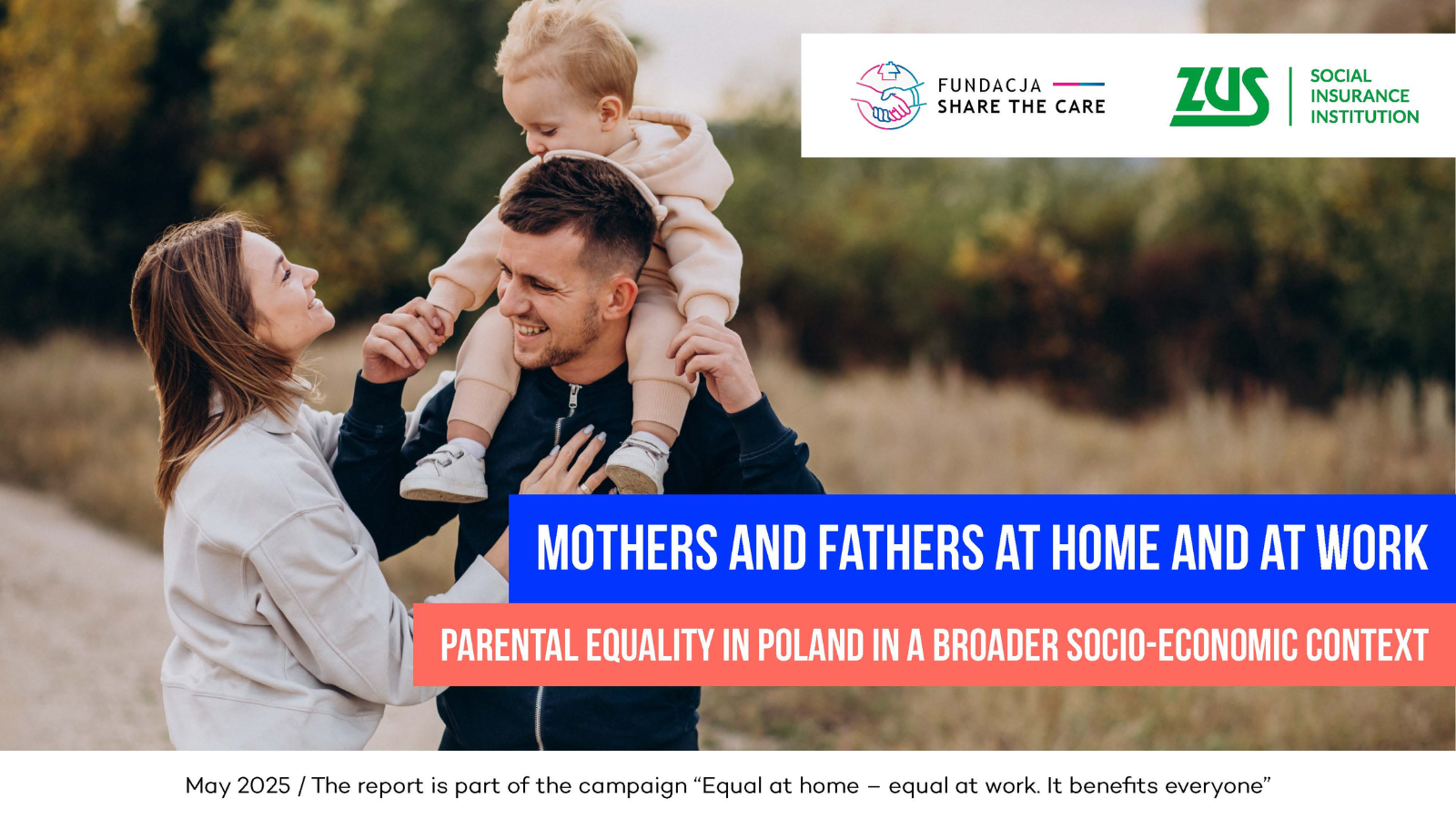
One of COFACE Families Europe’s member organisations, Fundacja SHARE THE CARE, has recently published a new report on work-life balance in Poland.
This report presents data and summarizes the effects of actions taken so far to create a modern and balanced ecosystem that supports parenthood and allows mothers and fathers to maintain work-life balance. This publication is addressed to a wide range of decision-makers – politicians, local government officials, public institutions, employers, and social organizations – who together have a real impact on shaping the living conditions of families in Poland.
Their goal is to build a common understanding of the need to support parents – both mothers and fathers – in their daily care and professional challenges.
Key findings
- Parental equality translates into equality of professional opportunities
The increase in the number of fathers taking parental leave in relation to the number of births from 1% in 2022 to 17% in 2024 (Social Insurance Institution data) is evidence of men’s growing awareness and activity in childcare. It is also the first step towards relieving women and enabling them to return to the labour market more quickly. Equal distribution of parental responsibilities directly translates into equality in professional development. - The difference in the amount of allowances for mothers and fathers is higher than the pay gap
In 2024, the average daily allowance for a father taking parental leave was PLN 167, and for a mother – PLN 124 (Social Insurance Institution data). This difference results from the level of remuneration, not the amount of benefits, and is over 30%. This is much more than the pay gap in Poland. - The use of parental leave is increasing, but not always in accordance with its purpose
The analysis of the use of parental leave by fathers, especially seasonality (with a peak in summer), indicates that some men may treat parental leave more as “free time” than as a real period of building bonds with the child. Further social education is needed on the role of the father in the family
and the function of these leaves in the context of parental equality. - Women still do most of the unpaid care work
79% of the number of days of absence due to caring for a sick child still concerns women (Social Insurance Institution data). - Employers are a key link in the system supporting parenthood
Without the conscious involvement of companies, and thus without updating procedures, educating
the management staff, open communication with employees and promoting equal use of leave, the regulations will remain dead. Not only employees lose out from the lack of support for parents, but also the organisations themselves and the economy. Forecasts of the Institute for Structural Research (IBS) indicate that by 2030, more than a million people will disappear from the labour market, and by 2050 – more than 4 million. In the face of these challenges, investing in parental equality and equality in the labour market, which guarantee the use of competences and talents of a wide range of employees, is a condition for business survival and development. - Cross-sectoral cooperation is the key to lasting change
Building a modern and balanced system supporting parenthood requires coherent action by the government, public institutions, employers, and non-governmental organisations. Each of these groups brings a unique perspective, but they can achieve a lasting effect only if they cooperate and communicate in a common language.