
Turin Declaration 2025
Across Europe, many persons with disabilities continue to face barriers in exercising their fundamental rights: notably their right to self-determination, including to choose where and with whom they live, to decide who supports them, and to participate fully in their communities. These rights are closely intertwined with the rights of their families and informal carers.
National support systems are fragmented, under-resourced, and inconsistent across countries and regions. Families, and especially women, fill in the gaps when systems fall short, providing essential care, often without recognition or support and at the expense of their time, employment, social life, and health, including mental health.
True autonomy and wellbeing are deeply rooted in meaningful relationships: between persons with disabilities, their families, friends, and wider communities. Services and policymakers must collaborate to create inclusive
spaces and supportive environments that foster these connections. Families and persons with disabilities should have the resources to build rich lives, grounded in belonging and choice.
We call on the EU and Member States to:
- Align national and EU policies with international human rights standards, including the UN Special Rapporteur’s 2025 recommendations on care and support for children with disabilities within the family environment and its gendered dimension.
- Ensure that children can grow in a family environment and support systems uphold the rights and choices of persons with disabilities, including who supports them and how. Acknowledge and support families in defining their role in caregiving, including the choice not to be primary carers for their adult relatives with disabilities. This requires ensuring the availability of rights-based and community-based support.
- Design and implement policies that promote gender equality in caregiving, also addressing the intersectionality of disability and motherhood, so that women with disabilities receive tailored support to overcome compounded barriers.
- Provide mechanisms for whole-life planning from (early) childhood through adulthood, and old age, ensuring continuity across transitions and empowerment of persons with disabilities. Making sure that the will and preferences of persons with disabilities are central to the planning that should be supported by continuous accessible communication as well as accessible, centralised information hubs and independent navigation, and advocacy services to guide families.
- Guarantee to persons with disabilities lifelong access to community-based care and support, healthcare, inclusive sports and social opportunities, early independence-building experiences and broaden employment pathways, including to those with high support needs.
- Invest in high-quality, community-based services that are accessible, affordable, and person-centred, with a long-term, prevention-oriented vision, and strong monitoring, evaluation, and quality assurance frameworks.
- Support the workforce delivering care and support with fair pay, training, and adequate resources, including appropriate staffing levels, to enable quality, person-centred approaches. Ensure workers’ mental health and well-being through prevention measures and regular supervision.
- Promote inclusive spaces and community participation, strengthening relationships and social connections, starting from early childhood.
- Provide carers with peer support networks, early training and mental health prevention and support measures, along with tailored approaches that reflect gender, cultural, and whole-family needs, including those of siblings and grandparents.
- Support informal carers with flexible work, social protection and adequate financial support, and community-based respite services, both in-home and through inclusive community activities.
- Meaningfully and systematically consult children and adults with disabilities and their carers to ensure their needs and aspirations drive support, and coproduction in the design, governance and evaluation of services and on disability mainstreaming in policies.
- Shift financing towards personalised funding models (including personal assistance, vouchers, personal budgets).
The EU must take a leading role in shaping inclusive and sustainable policies for the coming years. This requires concrete commitments at European level and in particular through:
- A strong follow up of the European Care Strategy, including an ambitious EU Care Deal, in consultation with social actors: Ensuring national action plans deliver long-term care that is affordable, timely, and comprehensive; continuously improving quality and accessibility; and that informal carers receive adequate support with financial, psychological, training, and respite measures.
- A Second phase of the EU Disability Rights Strategy (2026–2030): Strengthening early childhood intervention, supporting independent living and deinstitutionalisation, advancing access to employment, improving accessibility, guaranteeing legal capacity, and full implementation of the UNCRPD.
- A robust Child Guarantee implementation and monitoring: Ensuring children with disabilities and their families have effective access to early identification and intervention, inclusive education, healthcare, nutrition, and adequate housing and all support needed for them to avoid family separation, as well as
recognition and support for informal carers. This should be associated with strengthened data collection and accountability. - Actions for deinstitutionalisation in the Affordable Housing Plan: remove barriers to the access to housing of persons with disabilities including those with higher support needs, strengthen the role of community-based support services as housing providers for persons with disabilities, and improve crosssector collaboration between the housing and disability sectors.
- A comprehensive Action Plan under the European Pillar of Social Rights: Translating commitments on work-life balance, social protection, access to long-term care, and inclusion of persons with disabilities and carers into concrete, adequately funded initiatives, including the setting up of a European Long-Term Care Platform.
- Strengthened EU-level data collection: fund comparative research, and pilot innovative community-based care models to drive continuous improvement and shared policy learning among Member States.
Our shared committment
Together, we pledge to build systems where:
- Persons with disabilities exercise real choice and control.
- Families are recognised and supported, not overburdened.
- Services are valued, innovative, high-quality and sustainable and close to the people who need them.
We commit to work towards a Europe where support is a right, not a privilege; where autonomy and inclusion are the norm; and where everyone can live, love, and participate fully, across all ages, acknowledging that everyone may experience vulnerability or need support, at some point of their life.
Signatures
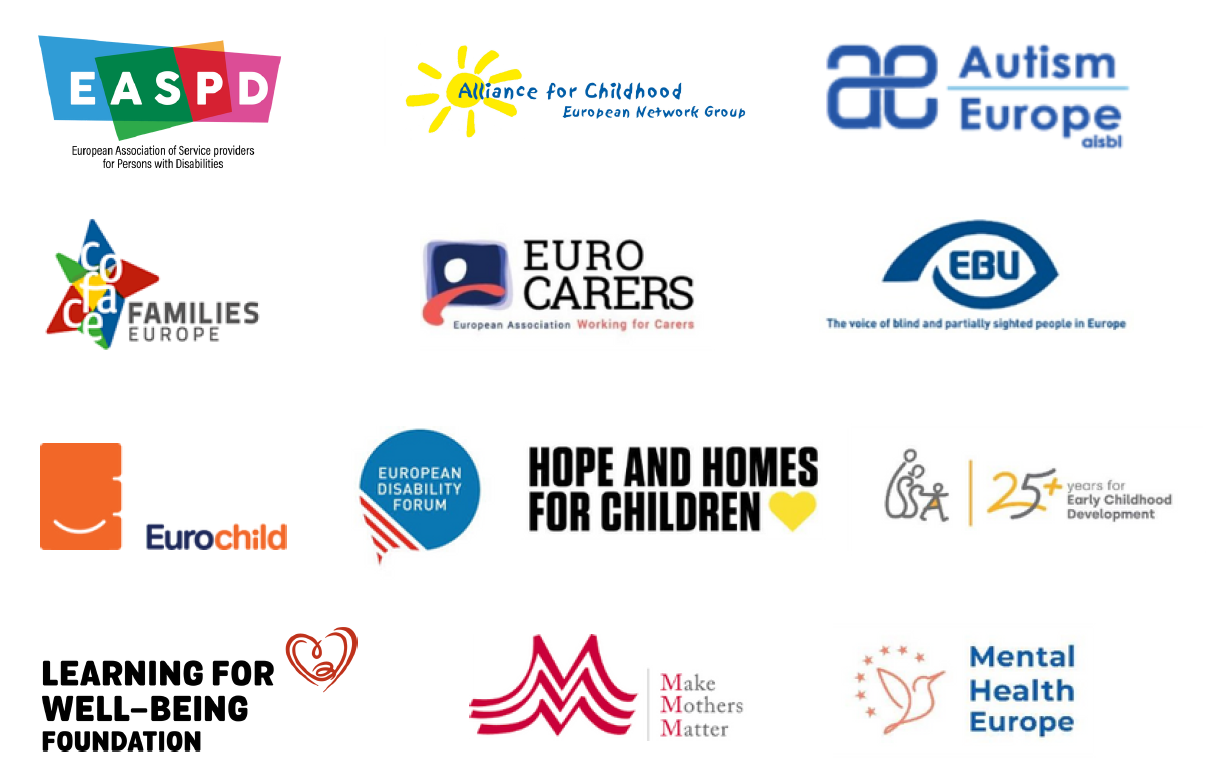
Signed by the below organisations in Turin on 21 October 2025.
EASPD | Alliance for Childhood | Autism Europe | COFACE Families Europe | Eurocarers | EBU | Eurochild | European Disability Forum | Hope and Homes for Children | ISSA | Learning for Wellbeing Foundation | Make Mothers Matters | Mental Health Europe