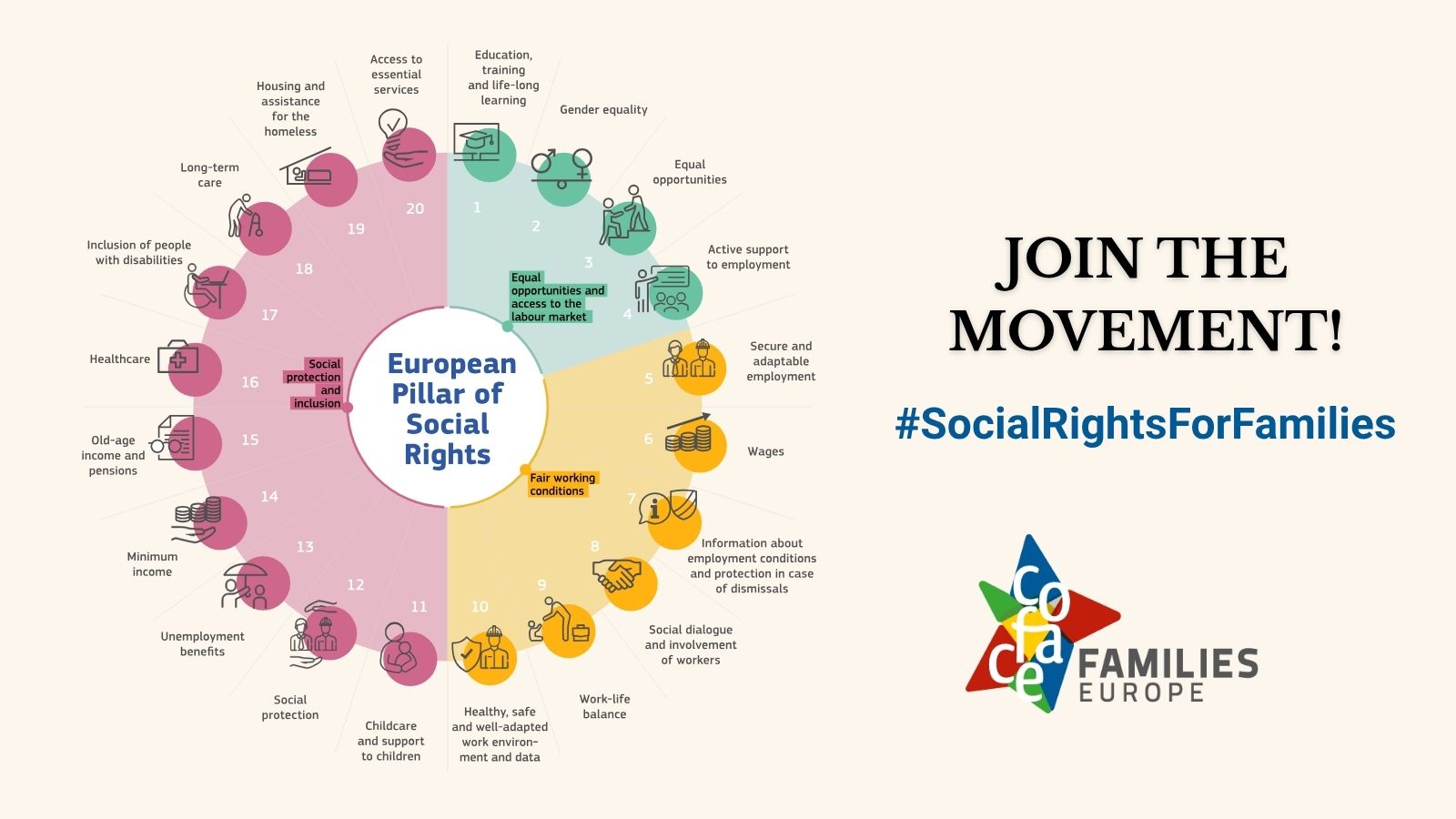
What is the European Pillar of social rights?
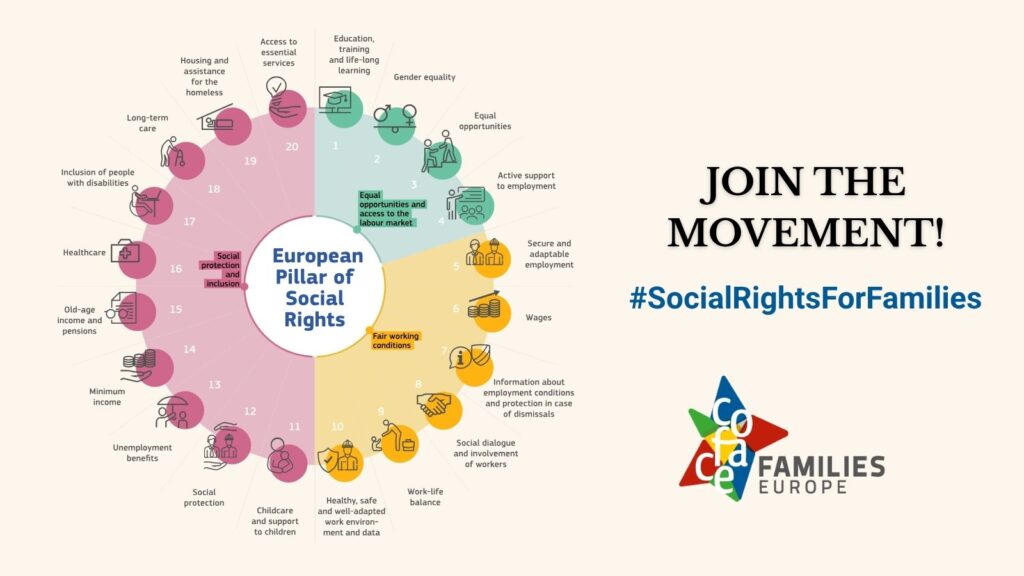
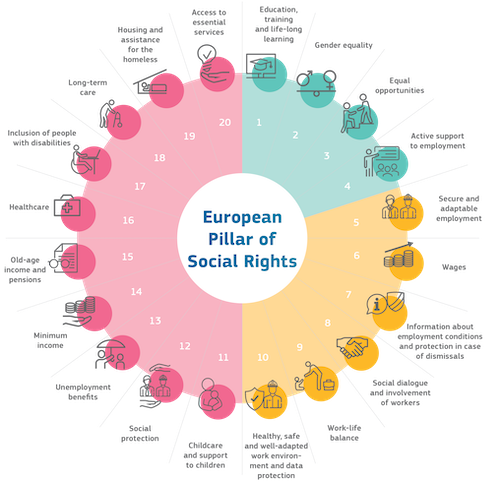
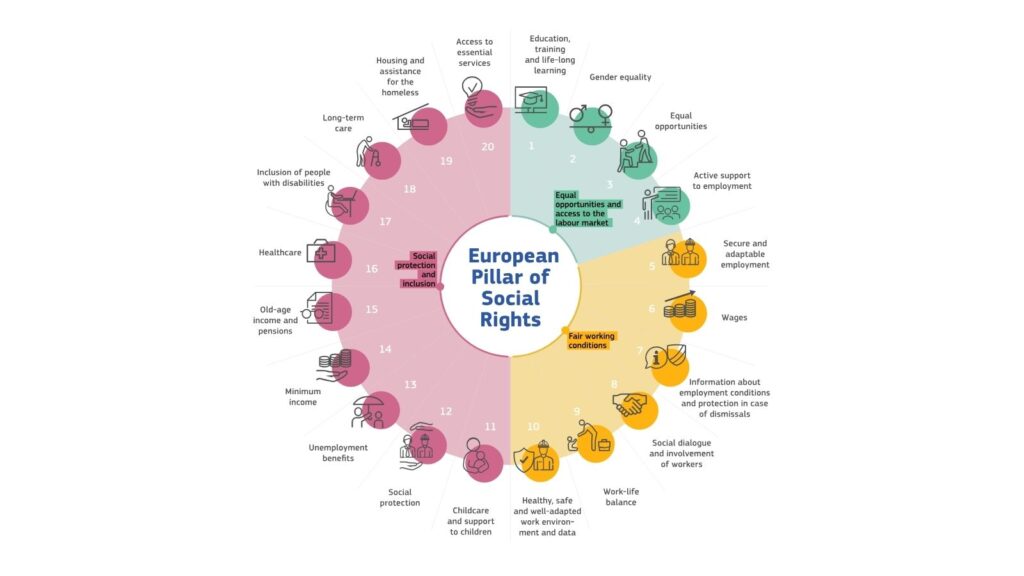
The European Union proclaimed the European Pillar of Social Rights in 2017 in Gothenburg, Sweden. The Pillar is a political document that sets out 20 key principles which guide European actions and laws to achieve a strong social Europe that is fair, inclusive and full of opportunity for families in the 21st century. These actions are collected in an action plan which was adopted in 2021 and revised in 2026.
The 20 principles are divided in three chapters.
1. Equal opportunities and access to the labour market
- Education, training and lifelong learning
- Gender equality
- Equal opportunities
- Active support for employment
2. Fair working conditions
- Secure and adaptable employment
- Wages
- Information about employment conditions and protection in cases of dismissal
- Social dialogue and involvement of workers
- Work–life balance
- Healthy, safe and well-adapted working environments, and data protection
3. Social protection and inclusion
- Childcare and support for children
- Social protection
- Unemployment benefits
- Minimum income
- Old-age income and pensions
- Healthcare
- Inclusion of people with disabilities
- Long-term care
- Housing and assistance for the homeless
- Access to essential services
From principles to action
The European Pillar of Social Rights Action Plan
The European Pillar of Social Rights Action Plan turns the 20 Principles into concrete actions to benefit citizens. It also proposes headline targets for the EU to reach by 2030.
More and better jobs
The EU aims to achieve an employment rate of at least 78% among people aged 20 to 64 by 2030, supporting job creation and quality employment, including in the green and digital transitions.
Skills and equal opportunities
By 2030, at least 60% of adults should participate in training every year. The objective is to equip people with the skills needed for a changing labour market while ensuring equal opportunities for all.
Social protection and inclusion
The EU aim to reduce the number of people at risk of poverty or social exclusion by at least 15 million by 2030, including at least 5 million children. Achieving this goal requires coordinated action to address poverty, inequality and social exclusion throughout the life course.
To help achieve these objectives, Member States of the EU have adopted national targets that reflect their specific circumstances while contributing to the EU-wide goals. Progress is monitored through tools called the “European Semester” and the “Social Scoreboard“, helping to ensure that commitments are translated into concrete action across Europe. The European Semester is the main European process aiming to coordinate economic, employment and social policies in the 27 countries of the EU. The EU Social Scoreboard is a tool that monitors social progress across EU countries by tracking key indicators on employment, education, equality, and living conditions.
Together, these targets provide a roadmap for implementing the European Pillar of Social Rights and creating a more inclusive, fair and resilient Europe.
Take a look at some of the specific initiatives of the European Pillar of Social Rights
Click on the different Principles below to see our factsheets containing key information about measures taken and why these matter.
- Principle 2: Gender equality
- Principle 9: Work-life balance
- Principle 11: Childcare and support to children
- Principle 14: Minimum income
- Principle 15: Old age income and pensions
- Principle 17: Inclusion of people with disabilities
- Principle 18: Long-term care
Principle 2: Gender equality
How does the Pillar help to boost equality between women and men?
“Equality of treatment and opportunities between women and men must be ensured and fostered in all areas, including regarding participation in the labour market, terms and conditions of employment and career progression.
Women and men have the right to equal pay for work of equal value.”
The Gender Equality Strategy 2020-2025 is the European Union’s framework for achieving a Union of equality, where women and men, girls and boys, in all their diversity, are free to pursue their chosen paths in life, have equal opportunities to thrive, and can participate equally in European society. Adopted in 2020, the Strategy sets out policy objectives and actions to tackle persistent gender inequalities and promote gender equality across all areas of life.
Despite progress in recent decades, gender inequalities remain. Women continue to be underrepresented in decision-making positions, are more likely to undertake unpaid care responsibilities, and face a gender pay and pension gap. Gender-based violence also remains a serious challenge across Europe.
Key priorities
The Strategy focuses on several key priorities:
- Ending gender-based violence and challenging gender stereotypes;
- Ensuring equal participation and opportunities in the labour market, including reducing gender employment gaps;
- Achieving equal pay for equal work and work of equal value and addressing the gender pay and pension gaps;
- Promoting gender balance in decision-making and leadership positions;
- Integrating a gender perspective into all EU policies and initiatives through gender mainstreaming and intersectional approaches.
Measures and actions
To achieve these objectives, the European Commission has introduced and supported a range of legislative and non-legislative measures, including:
- Measures to prevent and combat gender-based violence;
- Measures aimed at strengthening equal pay between women and men, through greater pay transparency in the workplace;
- Initiatives to improve gender balance on corporate boards and in leadership positions;
- Support for work-life balance policies that enable a more equal sharing of care responsibilities;
- The integration of gender equality objectives into EU funding programmes and policymaking processes.
In March 2026, the European Commission adopted the new Gender Equality Strategy 2026-2030. The strategy puts forward concrete actions to embed gender equality into every aspect of life, both online and offline, from education and health to work and leadership. It enlarges the scope of the previous strategy by covering all the principles of the Roadmap for Women’s Rights, which was endorsed by all Member States in 2025. In addition to ensuring that recently adopted gender equality legislation is duly implemented, the strategy tackles new threats such as gender-based cyberviolence, anti-gender narratives and AI-related risks, which particularly affect women. It upholds the approach of the previous strategy by adopting an intersectional perspective throughout, and combining gender mainstreaming with targeted actions.
Why it matters
Gender equality is a fundamental value of the European Union and a key principle of the European Pillar of Social Rights. Advancing equality benefits individuals, families and society as a whole. Greater gender equality contributes to higher employment, improved economic security, reduced poverty risks, stronger social inclusion and a more equal sharing of care responsibilities.
For families, gender-equal policies help create fairer opportunities for parents and carers, support work-life balance and strengthen the well-being of all family members.
However, achieving gender equality requires more than EU legislation alone. As highlighted by COFACE Families Europe, a combination of measures is needed to address the structural inequalities that continue to affect women in the labour market. These include expanding access to affordable childcare, promoting gender-equal parental leave and flexible working arrangements, ensuring family services are inclusive and father-friendly, challenging gender stereotypes around care and work, encouraging employers to adopt inclusive recruitment and workplace practices, and tailoring policies to national and regional contexts. Together, these measures can help create labour markets and societies where women and men have equal opportunities to participate in both paid work and family life.
Principle 9: Work-life balance
How does the Pillar support the work-life balance of parents and carers?
“Parents and people with caring responsibilities have the right to suitable leave, flexible working arrangements and access to care services. Women and men shall have equal access to special leaves of absence in order to fulfil their caring responsibilities and be encouraged to use them in a balanced way.”
The Work-Life Balance Directive adopted in 2019 is one of the flagship initiatives supporting the implementation of the European Pillar of Social Rights. It is also the first legislative initiative that follows the launch of the Pillar. It aims to help parents and carers better balance their professional and family responsibilities while promoting greater equality between women and men in both the workplace and at home. The Directive establishes minimum rights across the EU for parental, paternity and carers’ leave, as well as the right to request flexible working arrangements. It also seeks to encourage a more equal sharing of care responsibilities and increase women’s participation in the labour market to support their economic independence.
Key priorities
The Directive aims to increase the participation of women in the labour market, the take-up of family-related leaves and provides access to flexible working arrangements for parents and carers. According to Eurostat, women’s employment rate in the EU is 10 percentage points lower than men’s. Women also continue to bear a disproportionate share of unpaid care responsibilities, which can limit their participation in the labour market. The Directive allows workers leave to care for relatives who need support and overall helps parents and carers to reconcile professional and private lives through European minimum standards:
- Working fathers or equivalent second parents are entitled to at least 10 working days of paternity leave around the time of birth of the child. It must be compensated at least at the level of sick pay;
- Each parent is entitled to at least four months of parental leave, of which two months is paid and non-transferable. Parents can request to take their leave in a flexible form, either full-time, part-time, or in piecemeal;
- All workers providing personal care or support to a relative or person living in the same household have the right to at least five working days of carers’ leave per year. There are no European standards on the payment of carers’ leave;
- All working parents with children of up to at least eight years of age and all carers have the right to request reduced working hours, flexible working hours, and flexibility in the workplace.
In 2022, all Member States were required to adhere to these minimum European standards.
Measures and actions
In order to complement these minimum standards, the European Commission has made a set of recommendations to support Member States. These include:
- ensuring protection against discrimination and dismissal for parents (including pregnant women and workers coming back from a leave) and carers,
- encouraging a gender-balanced use of family-related leaves and flexible working arrangements,
- making better use of European funds to improve provision of formal care services (childcare, out-of-school care and long-term care),
- removing economic disincentives for second earners which prevent women from accessing the labour market or working full-time.
Why it matters
This initiative aims to benefit families, companies and the wider society. Parents and carers can benefit from a better work-life balance. Moreover, the foreseen increase in women’s employment, their higher earnings and career progression positively impacts their and their families’ economic prosperity, social inclusion and health.
Balancing work and family life is a challenge faced by millions of families across Europe. The Work-Life Balance Directive recognises that access to leave, flexible working arrangements and quality care services are essential for enabling parents and carers to participate in the labour market while fulfilling their caring responsibilities. By promoting a more equal sharing of care between women and men, the Directive also contributes to greater gender equality, improved family well-being and better outcomes for children and those in need of care.
For families, the Directive is particularly important because it helps create the conditions for combining employment with family life throughout the life course. Accessible parental and carers’ leave, flexible working arrangements and stronger protection against discrimination can reduce financial insecurity, improve work-life balance and support equal opportunities in both professional and family life. As highlighted by COFACE Families Europe, effective implementation of the Directive, alongside investment in quality and affordable care services, is key to ensuring that all families can thrive and fully participate in society.
- Read more here about the Work-Life Balance Directive
- Read here COFACE’s 2022 assessment of the Directive transposition into national legislation

Principle 11: Childcare and support to children
How does the Pillar help children at risk of poverty?
“Children have the right to affordable early childhood education and care of good quality.
Children have the right to protection from poverty. Children from disadvantaged backgrounds have the right to specific measures to enhance equal opportunities.”
As part of the European Care Strategy, the European Commission proposed revised childcare targets (called the “Barcelona targets”) for 2030, namely to increase access to early childhood education and care and support parents’ participation in the labour market. Under this new framework, Member States are encouraged to ensure that:
- At least 50% of children under the age of three participate in early childhood education and care;
- At least 96% of children between the age of three and compulsory primary school age participate in early childhood education and care.
The European Child Guarantee is another flagship initiative of the European Pillar of Social Rights aimed at preventing and combating child poverty and social exclusion. Adopted by the Council of the European Union in June 2021, the Guarantee seeks to ensure that every child in need has access to essential services that are fundamental to their well-being, development and future opportunities.
The initiative recognises that poverty and disadvantage experienced during childhood can have lifelong consequences, affecting educational outcomes, employment opportunities, health and social participation. By investing in children and ensuring equal access to key services, the European Child Guarantee aims to break cycles of poverty and disadvantage across generations.
Key priorities
The European Child Guarantee aims to guarantee effective access for children in need to six essential services:
- Free early childhood education and care;
- Free education, including school-based activities;
- At least one healthy meal during each school day;
- Free healthcare;
- Healthy nutrition;
- Adequate housing.
Particular attention is given to vulnerable groups of children, including children with disabilities, children from a minority racial or ethnic background (particularly Roma children), children experiencing homelessness, children with a migrant background, children in alternative care and children living in precarious family situations.
Measures and actions
To implement the Guarantee, Member States have developed National Action Plans covering the period until 2030. These plans outline measures to improve access to the six key services and address the barriers that prevent children and families from accessing them. Member States are also required to report regularly on progress made in implementing the Guarantee.
The initiative is supported through EU funding instruments, particularly the European Social Fund Plus (ESF+). Countries with above-average levels of child poverty are required to dedicate at least 5% of their ESF+ resources to tackling child poverty and social exclusion.
In 2026, the European Commission strengthened the European Child Guarantee as part of the EU Anti-Poverty Strategy, placing renewed emphasis on improving access to quality services, supporting vulnerable children and preventing the rising cost of living from pushing more families into poverty.
The 2026 Communication on the European Pillar of Social Rights Action Plan directly mentions the Strengthening of the European Child Guarantee as an essential instrument for promoting well-targeted, place-based, and person-centred social investment, improving intergenerational equity, and preventing the accumulation of social disadvantages.
Under the EU Anti-Poverty Strategy, this is complemented by a planned 2027 Council Recommendation to improve the efficiency and integration of child-related benefit systems, alongside a Toolkit bridging the Child Guarantee and Youth Guarantee.
Why it matters
Nearly one in five children in the European Union is at risk of poverty or social exclusion. The European Child Guarantee recognises that children’s well-being depends not only on their individual circumstances but also on the support available to their families and communities. By improving access to education, healthcare, nutrition, housing and childcare, the initiative seeks to ensure that all children have the opportunity to thrive, regardless of their background.
For COFACE Families Europe, the European Child Guarantee is particularly important because it promotes a holistic approach to child well-being that supports both children and their families. This includes ensuring that children with disabilities and other vulnerable groups can access the services they need to participate fully in society and enjoy equal opportunities throughout their lives.
Principle 14: Minimum income
How does the Pillar help tackle and prevent family poverty?
“Everyone lacking sufficient resources has the right to adequate minimum income benefits ensuring a life in dignity at all stages of life, and effective access to enabling goods and services. For those who can work, minimum income benefits should be combined with incentives to (re)integrate into the labour market.”
The EU Anti-Poverty Strategy is the European Union’s first comprehensive strategy dedicated to preventing and reducing poverty and social exclusion. Presented by the European Commission in May 2026, it provides a roadmap to achieve the European Pillar of Social Rights target of reducing the number of people at risk of poverty or social exclusion by at least 15 million by 2030, while setting the longer-term ambition of helping to eradicate poverty in the EU by 2050.
The Strategy responds to growing social challenges across Europe. Today, around one in five Europeans is at risk of poverty or social exclusion, while one in four children faces the same risk. Rising living costs, housing pressures and labour market changes have increased financial insecurity for many households.
Key priorities
The EU Anti-Poverty Strategy is built around three main priorities:
- Quality jobs for all, recognising that decent employment is one of the most effective ways to prevent and reduce poverty;
- Effective access to quality services and adequate income support, ensuring that people can access the resources and support they need to live with dignity;
- Coordinated action against poverty, bringing together EU institutions, Member States, regional and local authorities, social partners and civil society organisations.
Measures and actions
The Strategy is accompanied by several initiatives aimed at addressing the root causes of poverty and social exclusion, including:
- A strengthened European Child Guarantee to break the cycle of child poverty;
- A Council Recommendation on fighting housing exclusion, promoting prevention, affordable housing and long-term solutions to homelessness;
- Measures to improve access to social protection and adequate income support;
- Actions to support people facing barriers to employment and those most vulnerable to poverty;
- Greater involvement of people experiencing poverty in the design of policies that affect them.
To drive these actions forward, the Strategy operationalises a comprehensive life-course, horizontal, and structural framework. Specific upcoming measures include:
- a 2026 first-phase consultation of EU social partners on activating persons facing significant barriers to employment (with a strong emphasis on gender equality and childcare),
- a 2027 Commission Recommendation to prevent in-work poverty by improving work intensity and tax-benefit alignment,
- a monitoring report on the Adequate Minimum Wages Directive, and
- an enhanced Disability Employment Package.
Furthermore, to tackle housing exclusion, the Commission has put forward the Affordable Housing Act alongside a Council Recommendation on fighting housing exclusion.
Why it matters
Poverty affects every aspect of family life, including housing, health, education, employment and social participation. Children who grow up in poverty are significantly more likely to experience poorer health, lower educational outcomes and continued disadvantage later in life, making early intervention essential to breaking intergenerational cycles of poverty. By combining employment, social protection, housing and child-focused measures, the EU Anti-Poverty Strategy aims to build a more inclusive and resilient Europe where everyone has the opportunity to participate fully in society.
For COFACE Families Europe, the Strategy is particularly relevant because it recognises the essential role of families in preventing and overcoming poverty while highlighting the importance of accessible services, adequate income support and targeted action to support children and families. COFACE has developed a position paper on prevention of family poverty, outlining a comprehensive family-centred framework for preventing poverty and mitigating social exclusion based on a three-tiered approach: primary (universal), secondary (targeted) and tertiary (crisis) prevention. The framework is supported by four essential pillars: Adequate Resources, Accessible Services, Time Sovereignty and Integrated Governance. Together, these measures aim to address the multidimensional nature of poverty by promoting coordinated policies that strengthen families and prevent disadvantage across the life course.
- Read more here about the EU Anti-Poverty Strategy
- Read here COFACE’s position on prevention of family poverty, adopted in 2025.

Principle 15: Old age income and pensions
How does the Pillar promote solidarity between younger and older persons?
“Workers and the self-employed in retirement have the right to a pension commensurate to their contributions and ensuring an adequate income. Women and men shall have equal opportunities to acquire pension rights.
Everyone in old age has the right to resources that ensure living in dignity.”
The Intergenerational Fairness Strategy is the European Union’s first strategy dedicated to ensuring that the interests of present and future generations are considered in policymaking. Adopted by the European Commission in March 2026, the Strategy seeks to strengthen long-term thinking in EU decision-making and ensure that the benefits and responsibilities of today’s choices are shared fairly across generations.
The Strategy was announced in the 2024-2029 Political Guidelines of Commission President Ursula von der Leyen and responds to major challenges shaping Europe’s future, including demographic change, climate change, digitalisation, labour market transformations and geopolitical developments. It aims to ensure that policies adopted today contribute positively to the opportunities and well-being of future generations while promoting solidarity between all age groups.
Key priorities
The Strategy is built around an “Intergenerational Contract” based on three pillars:
- Fair policymaking, ensuring that future impacts are considered through foresight tools and a stronger focus on young people’s perspectives;
- Fair opportunities, tackling age-related inequalities and ensuring equal opportunities throughout the life course;
- Fair places, ensuring that where a person is born or lives does not determine their future opportunities.
Measures and actions
To support these objectives, the Strategy introduces several initiatives, including:
- An Intergenerational Fairness Index to identify opportunities and gaps and help policymakers assess impacts across generations;
- A Future-Oriented Policymaking Package to strengthen long-term planning and future literacy in public administrations;
- A Demography Forum to encourage dialogue and exchange on demographic developments across Europe;
- The Voices of the Future initiative, which will engage local and regional authorities in shaping policies with future generations in mind.
The Strategy also provides a framework for connecting existing policy areas that contribute to intergenerational fairness, including education, housing, employment, care, social inclusion and environmental sustainability.
Why it matters
Intergenerational fairness is about ensuring that today’s decisions do not create unfair burdens for future generations while also addressing the needs of people currently facing disadvantage. The Strategy recognises that challenges such as population ageing, housing affordability, access to care and climate change affect generations differently and require long-term solutions.
For families, the Strategy is particularly relevant because it adopts a life-course approach, recognising that people experience different needs and responsibilities at different stages of life. Strong family policies, quality care systems, affordable housing, inclusive education and social protection all contribute to greater fairness between generations. As highlighted by COFACE Families Europe (see article here), the Strategy has the potential to strengthen family well-being, promote solidarity between generations and support cooperation between younger and older generations in building more resilient societies.
Read more here about the Intergenerational Fairness Strategy
Principle 17: Inclusion of people with disabilities
How does the Pillar help families with disabilities?
“People with disabilities have the right to income support that ensures living in dignity, services that enable them to participate in the labour market and in society, and a work environment adapted to their needs.”
The Strategy for the Rights of Persons with Disabilities 2021-2030 is the European Union’s framework for ensuring that persons with disabilities can fully participate in society on an equal basis with others. Building on the principles of equality, inclusion and accessibility, the Strategy aims to remove barriers that prevent persons with disabilities from exercising their rights and participating in all aspects of life. In May 2026, the European Commission strengthened the Strategy with a renewed focus on implementation, delivery and tangible impact for the approximately 90 million people with disabilities living in the EU.
Despite progress in recent years, persons with disabilities continue to face significant challenges in employment, education, healthcare, housing, transport and political participation. The enhanced Strategy seeks to address these barriers and ensure that disability rights become a reality in everyday life.
Key priorities
The Strategy focuses on four overarching priorities:
- Turning rights into reality, ensuring that rights guaranteed at EU level translate into concrete improvements in people’s daily lives;
- Equal access and equal rights, promoting independent living, quality employment, inclusive education and equal access to healthcare and justice;
- Delivering across borders, strengthening disability inclusion in the EU’s external action and international partnerships;
- Leading by example, making EU institutions more accessible and inclusive.
Measures and actions
To achieve these objectives, the European Commission has launched a range of initiatives, including:
- The full rollout of the European Disability Card and European Parking Card, facilitating recognition of disability status across Member States;
- Measures to improve access to affordable and accessible assistive technologies and artificial intelligence tools;
- Actions to improve accessibility in rail, maritime and air transport;
- Efforts to make democratic participation and elections more accessible;
- The creation of an EU Alliance for Independent Living to support deinstitutionalisation and community-based support;
- Strengthening the Disability Employment Package to improve labour market opportunities and workplace inclusion;
- Promoting inclusive education and lifelong learning;
- Improving access to healthcare, justice and emergency preparedness for persons with disabilities.
The enhanced Strategy also includes nine flagship initiatives covering areas such as assistive technologies, accessible transport, disability cards, independent living, employment, lifelong learning and disability-inclusive crisis preparedness. These initiatives will be further developed in cooperation with organisations representing persons with disabilities and their families, including COFACE Families Europe.
Why it matters
Disability inclusion is a fundamental right and a key component of the European Pillar of Social Rights. Accessible services, inclusive education, quality employment and independent living are essential for ensuring that persons with disabilities can participate fully in society and enjoy equal opportunities throughout their lives.
For families, disability policies are particularly important because disability often affects not only individuals but also their support networks and caregivers. Families may face additional challenges related to care, accessibility, employment and financial security. As highlighted by COFACE Families Europe (see article here), the renewed Strategy offers an opportunity to strengthen support for persons with disabilities and their families, while ensuring that disability inclusion is considered across all relevant policy areas, from education and employment to housing, care and social protection.
- Read more here about the Strategy for the Rights of Persons with Disabilities
- Read here COFACE’s Guide to shift towards meaningful inclusion of persons with disabilities and their families.
Principle 18: Long-term care
How does the Pillar help family carers?
“Everyone has the right to affordable long-term care services of good quality, in particular home-care and community-based services.”
The European Care Strategy is a key initiative supporting the implementation of the European Pillar of Social Rights. Adopted by the European Commission in September 2022, the Strategy aims to ensure that care services across the European Union are high-quality, affordable and accessible, while improving the situation of both care receivers and carers, whether they provide care professionally or informally. It covers care throughout the life course, from early childhood education and care to long-term care for older persons and persons with disabilities.
As Europe’s population ages and care needs increase, the Strategy seeks to strengthen care systems, address labour shortages in the care sector and improve work-life balance for families. It also recognises the important role of care measures to promote gender equality, as women continue to carry the majority of both paid and unpaid care responsibilities.
Key priorities
The European Care Strategy focuses on four main priorities:
- Improving access to affordable, high-quality and accessible care services for children, older persons and persons with disabilities;
- Supporting carers, including informal/family carers, through better working conditions, work-life balance measures and targeted support;
- Strengthening the care workforce by improving working conditions, skills development and the attractiveness of care professions;
- Promoting gender equality by reducing the unequal distribution of care responsibilities and supporting women’s participation in the labour market.
Measures and actions
The Strategy is accompanied by two Council Recommendations covering early childhood education and care, and long-term care. Together, these initiatives encourage Member States to:
- Expand access to early childhood education and care, with EU targets to meet;
- Improve the affordability, availability and quality of long-term care services;
- Support informal carers through training, counselling and financial support;
- Improve wages, working conditions and training opportunities for care workers;
- Address labour shortages in the care sector;
- Develop national policies and investments that strengthen care systems and ensure equal access to quality care services.
Why it matters
Quality care services are essential for family well-being, social inclusion and economic participation. Accessible childcare supports children’s development and helps parents reconcile work and family life. Affordable and high-quality long-term care enables older persons and persons with disabilities to live independently and with dignity.
For families, the European Care Strategy represents an important step towards recognising care as a shared social responsibility. By investing in care services and supporting carers, the Strategy contributes to stronger families, greater gender equality and more inclusive societies across Europe.
Further reading
Find more useful resources and learn more about the European Pillar of social rights:
European Pillar of Social Rights in 20 principles
Easy-to-read version of the 20 principles
European Pillar of Social Rights Action Plan (2026)
Study by the European Economic and Social Committee on the State of play and country reports in 2024
COFACE Families Europe and the European Pillar of Social Rights
COFACE Families Europe has been closely engaged with the European Pillar of Social Rights since its development, contributing to discussions that helped shape the Pillar and advocating for a strong social dimension that reflects the realities and needs of families across Europe. Since its proclamation in 2017, COFACE has supported the implementation of the Pillar by promoting policies that strengthen work-life balance, quality and accessible childcare, social inclusion, inclusive education and equal opportunities for all family members, including persons with disabilities. Read more about how COFACE contributed to shaping the initial European Pillar of Social Rights here.
As the European Pillar of Social Rights continues to evolve, COFACE remains actively engaged in supporting its implementation, evaluating its impact and shaping its future. In 2025, COFACE contributed to the European Commission’s public consultation on the new European Pillar of Social Rights Action Plan, bringing the perspectives of families into the discussion on the next phase of implementation. Through ongoing policy advocacy, dialogue with EU institutions and collaboration with its network of member organisations (representing all types of families without discrimination), COFACE works to ensure that the voices and experiences of families continue to inform Europe’s social agenda. By contributing to both the implementation and the future development of the Pillar, COFACE supports the ambition of building a more inclusive, resilient and family-friendly Europe.
In July 2026, the European Commission published a Communication highlighting its renewed commitment to a future-ready Social Europe. COFACE has taken a close look at this Communication of the European Commission, focusing on specific aspects relevant to families. We have namely assessed progress of the EU in strengthening the social rights of families, and key new actions identified in the Communication which are relevant to help families reconcile their work and care responsibilities. Download the full assessment by clicking here or on the picture below.
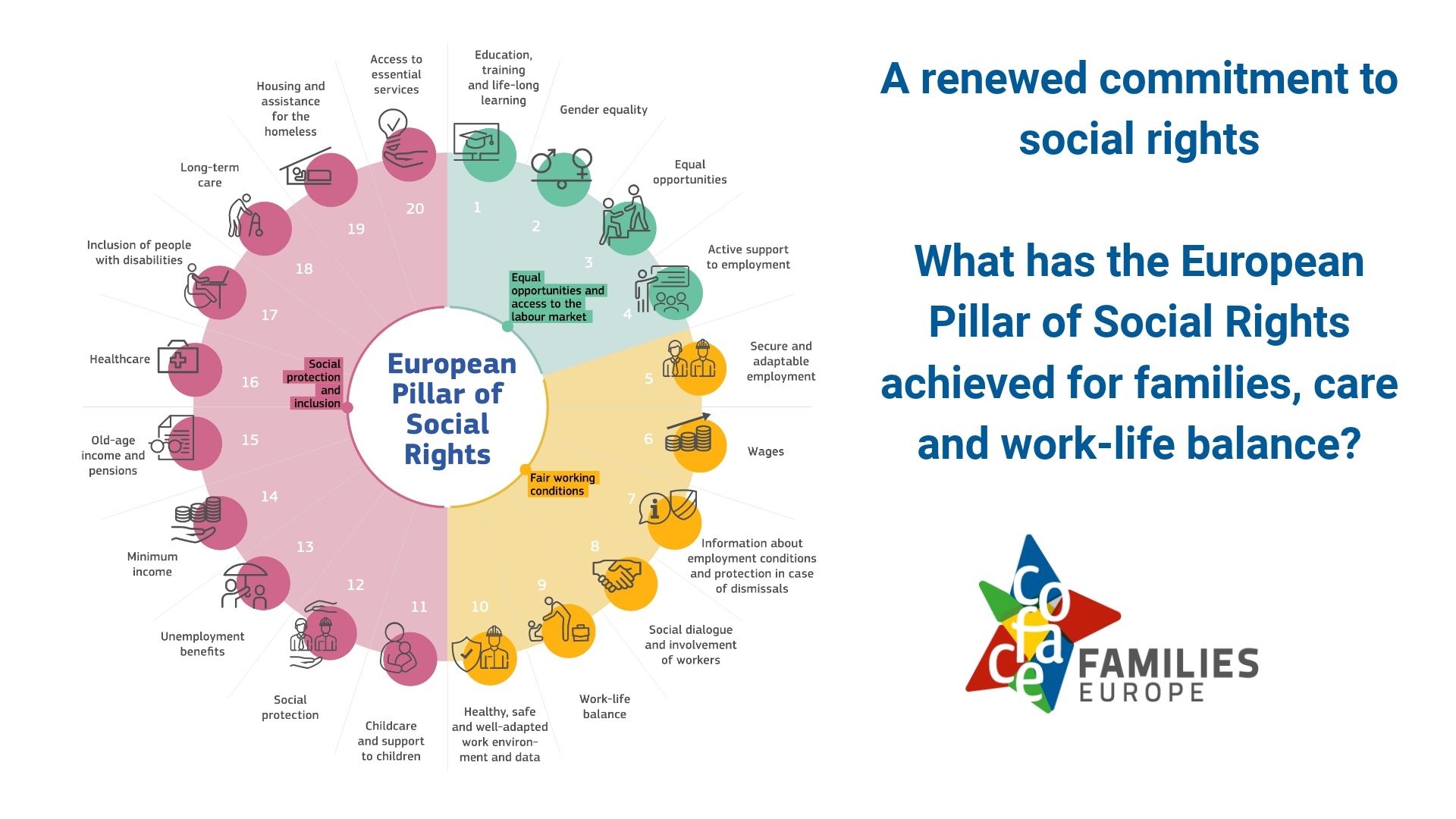
A renewed commitment to social rights: What has the European Pillar of Social Rights achieved for families, care and work-life balance?
Why did we launch this campaign and what does it aim to achieve?
COFACE Families Europe launched this campaign to show how the European Pillar of Social Rights can improve everyday life for families across Europe. It highlights EU initiatives that support work-life balance, affordable childcare, gender equality, intergenerational fairness, the fight against poverty and social exclusion, children’s rights and the inclusion of persons with disabilities.
The campaign explains what these initiatives aim to achieve and why they matter for families. It also brings together COFACE resources, publications, encourage engagement and show how social rights can be put into practice.
Why should you join the movement?
Join our movement to spread information about European social rights. You’ll find various resources here which can be used by :
- family NGOs to raise awareness on how the EU supports families
- teachers when talking about European geography and how countries work together
- university professors for their courses on the Social Europe and the impact of social and employment policies
- researchers to help fill gaps in knowledge about social and family policy
Click here to put your ideas in practice through our Communication Toolkit.
Stay connected to the COFACE Families Europe network
Click here to subscribe to our newsletter to receive updates on European social rights for families.