Open letter: Investing in people and regions in the next EU budget
To: The Heads of State or Government of the European Union
Cc: António Costa, President of the European Council; Micheál Martin, Taoiseach (Irish Presidency of the Council)
Brussels, 24 November 2026
_________
Dear Heads of State or Government,
Ahead of the European Council of 26–27 November, we write on behalf of the EUFunds4Social Coalition, which brings together European networks and national organisations including NGOs, social services, public health and service providers, lifelong learning and social economy actors, workers, and social partners. This letter is supported by 280 organisations: 53 international and European networks and 227 national organisations from 23 EU Member States and 7 other countries.
We welcome the work of President Costa and of the Irish Presidency to move the negotiations on the 2028–2034 Multiannual Financial Framework forward, and we recognise the difficult context in which you are preparing the next EU budget; however, Europe must deliver on the Treaty objective of economic, social and territorial cohesion.
We therefore reiterate our call on you to support strong EU social funding and in particular:
- Agree an overall budget in line with the European Parliament’s position of 1.27% of EU GNI.
- Secure adequate resources for Heading 1, and place NextGenerationEU repayments outside the ceilings, as the European Parliament proposes.
- Preserve what the ESF and the ERDF guarantee: stand-alone funds with €124bn for the ESF, as the European Parliament proposes, or at the very least dedicated, ring-fenced envelopes with their own objectives in every national plan, at least at current levels adjusted for inflation.
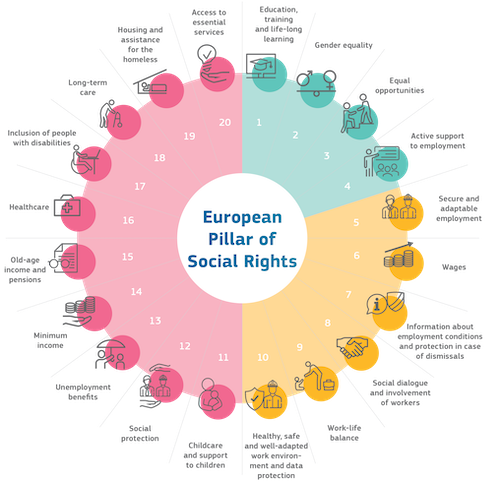
- Raise the social spending target from 14% to at least 25% of the National and Regional Partnership Plans, to implement the European Pillar of Social Rights and respond to today’s pressing social challenges, and introduce realistic co-financing rates.
- Earmark direct EU funding for social innovation, capacity building and transnational cooperation of civil society organisations and social partners, and social economy actors within the EU Facility.
The negotiating box President Costa presented on 21 November puts social and territorial investment under further pressure. It reduces the overall budget to €1.582 billion, around 10% below the Commission proposal. Heading 1, which funds cohesion and social policies, is cut again while still absorbing the repayment of NextGenerationEU. Quality employment is now among its objectives, a commitment that requires adequate resources, while the National and Regional Partnership Plans lose €7.7 billion compared with the Irish Presidency Negotiating box presented in October. The 14% social spending target now applies to a smaller fund, and the EU Facility still sets no amount aside for social innovation, capacity building or civil society.
Social and territorial investment is key to helping Europe respond to the major challenges of our time: rising inequality and polarisation, underinvestment in public services, the urban–rural divide, demographic ageing, skills shortages and a high need of upskilling and reskilling, high youth unemployment and inactivity, and the digital and climate transitions. The European Social Fund and the European Regional Development Fund, both grounded in the EU Treaties, support quality employment, foster social cohesion and protect rights in every region of the Union. In doing so, they strengthen the foundations of our societies, our democracy and Europe’s competitiveness.
We want an EU budget that continues to invest in people, communities, quality services and the social economy, with strong social funding and effective guarantees for inclusion. That means protecting people-centred support and minimum spending for social inclusion, child poverty, homelessness, health, youth employment and material deprivation, and keeping enabling conditions linked to the UN Convention on the Rights of Persons with Disabilities and the European Pillar of Social Rights. It also means giving social partners, civil society and people with lived experience a real role in the design, governance and monitoring of programmes, and keeping EU funding accessible to not-for-profit organisations, for example by exempting them from co-financing requirements when they support groups facing heightened vulnerabilities or pursue social inclusion priorities, in the NRPP Regulation. This is how Europe’s social market economy can remain a source of resilience in an uncertain world.
We stand ready to work with you, the Irish Presidency and the European Parliament towards an EU budget that delivers for people and regions.
Yours sincerely,
The EUFunds4Social Coalition